

Restoring hulls, preserving memory, and educating the next generation — from the inland city of Pessac, at the heart of France's greatest estuary.
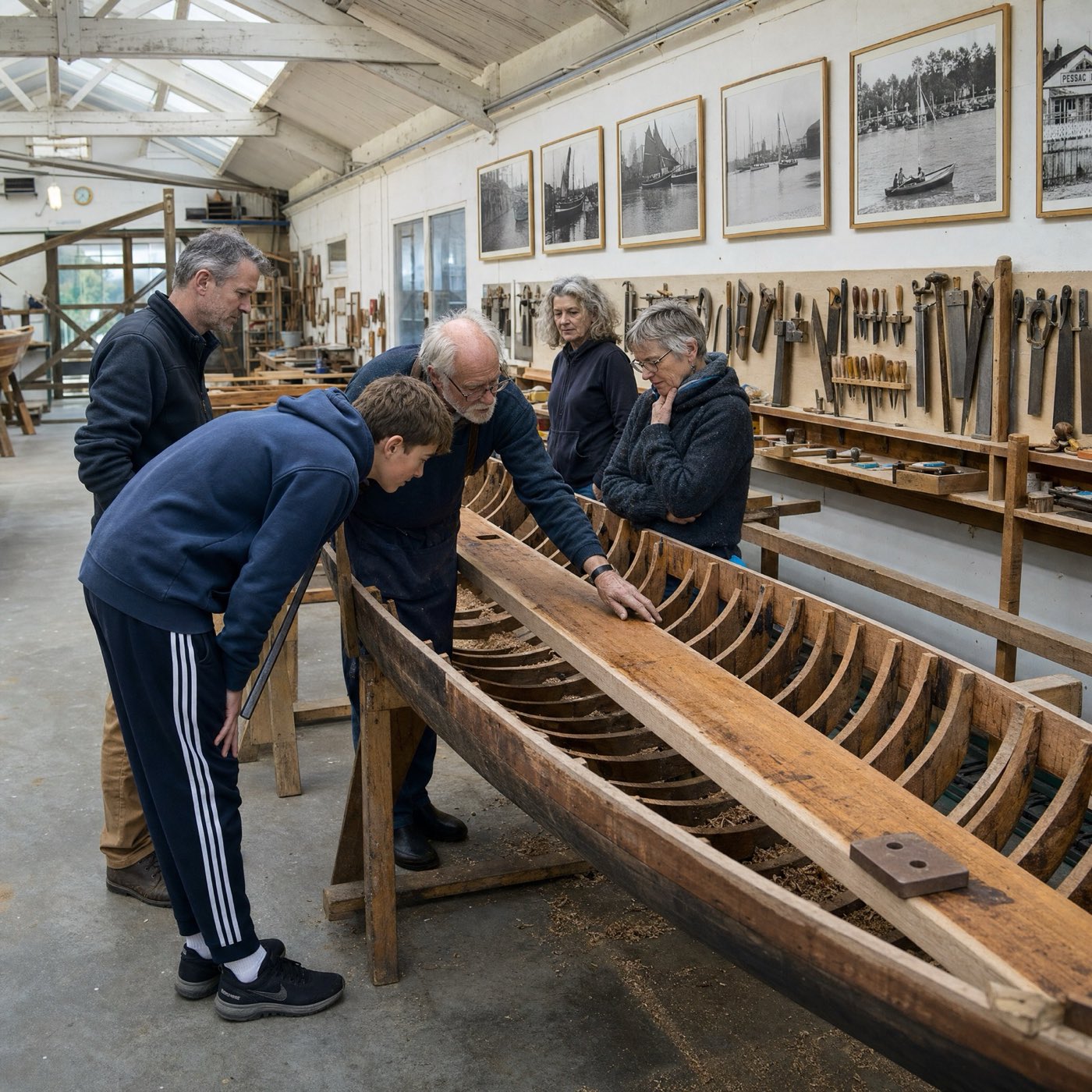
The Sauvegarde du Patrimoine Maritime Girondin is a regional association whose member sections work across the Gironde département and beyond to preserve the material culture, craft knowledge, and collective memory of France's largest estuary. Our section, based in Pessac, was established to ensure that this mission reached inland communities — demonstrating that the heritage of the Gironde is not the exclusive concern of port towns but belongs equally to every city and village that the waterways have fed, connected, and defined.
We operate as an association loi 1901, governed by a volunteer board of trustees and sustained by the dues of our members, the generosity of donors, and occasional project funding from the Région Nouvelle-Aquitaine and the Bordeaux Métropole. Our atelier in Pessac serves as both a practical workspace and a public venue: members of the community are welcome to visit during our open sessions, to watch the restoration work in progress, to handle tools and materials, and to speak with the skilled volunteers who carry this craft knowledge forward.
Over the years we have built a reputation for rigour and warmth in equal measure. Our restoration work is guided by documentary research — we consult naval architects' plans, old photographs, and the recollections of former mariners before we touch a hull — and our archiving practice follows standards that allow our collections to integrate with regional and national heritage databases. At the same time, we are a convivial association: our annual estuary day, our winter lectures, and our monthly working sessions around the boats are as much about community as they are about craftsmanship.
The Section de Pessac was born from a conversation at a kitchen table in the late 1990s between a retired naval carpenter originally from Blaye and a Pessac secondary-school history teacher who had been struggling to find tangible, local material for a unit on the Gironde's working waterways. They contacted the parent association, gathered a handful of like-minded neighbours, and formally registered the section in 2001. The founding members began with almost nothing — a borrowed trailer, a battered gabarre hull salvaged from a backyard in Ambarès, and an address book of retired mariniers willing to share their knowledge.
That gabarre, the Sainte-Eulalie, was restored over three winters and launched in 2005 to considerable local press attention. She remains the centrepiece of our collection today. In the two decades since, the section has grown steadily without ever losing the intimate, hands-on character of those first winter evenings in a cold workshop. We have survived the loss of founding members, changes of premises, and the particular challenges of the pandemic years — during which we turned to digital oral-history recording and online lectures to maintain our community's connections.
What has never wavered is the conviction that drove those first volunteers: that the crafts, the stories, and the vessels of the Gironde estuary are irreplaceable, and that losing them to neglect would be a quiet catastrophe for the cultural identity of the entire region. Every new member who picks up a hand-plane for the first time in our atelier, every schoolchild who touches the ribs of a restored hull and asks how it was made, is proof that the mission remains as urgent as it ever was.
Sauvegarde du Patrimoine Maritime Girondin — Section de Pessac exists to identify, preserve, restore, and transmit the maritime and fluvial heritage of the Gironde estuary, with particular attention to the traditional watercraft, craft trades, and seafaring lifeways that defined the region's economy and social fabric for centuries. We pursue this mission through practical restoration work carried out to the highest documentary and technical standards, through the systematic collection and safeguarding of oral histories and archival material, through education programmes that connect young people and the wider public with this heritage in direct and meaningful ways, and through active collaboration with the parent association, partner institutions, and communities along the estuary. We believe that heritage is not a passive inheritance but a living practice — one that demands sustained effort, specialist knowledge, and genuine community engagement to keep alive.
The crafts, the stories, and the vessels of the Gironde estuary are irreplaceable — losing them to neglect would be a quiet catastrophe for the cultural identity of the entire region.
Section de Pessac, founding statementThe Section de Pessac is led by a volunteer board of trustees who bring together expertise in maritime history, traditional boatbuilding, archival practice, education, and financial management. They are supported by a broader membership that includes active restorers, oral-history volunteers, educators, and the friends and families who make our events and open days such a distinctive part of Pessac's cultural calendar.